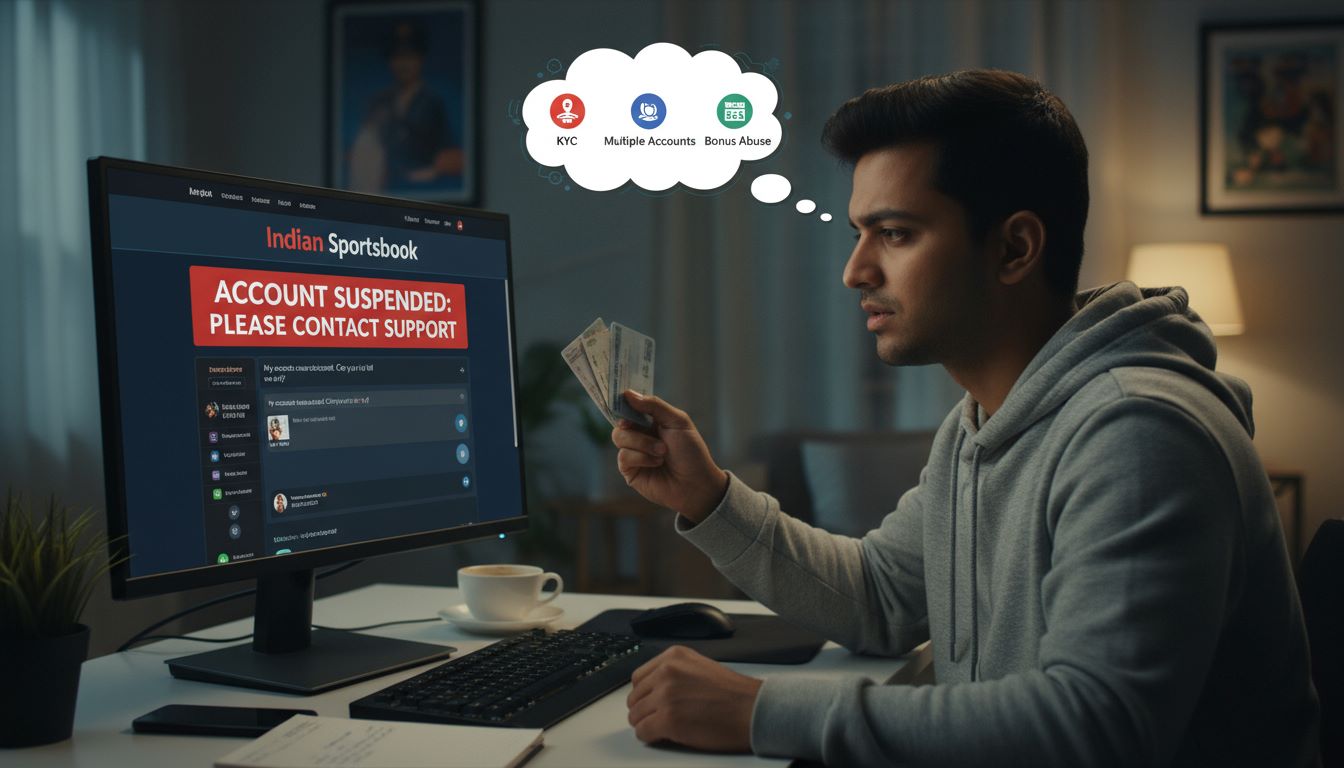
Understanding account suspension causes in sportsbooks
Account suspensions in Indian sportsbooks have become increasingly common as operators navigate complex regulatory environments and heightened security requirements. These suspensions stem from various causes including regulatory compliance issues, behavioral violations, and technical security concerns that affect thousands of users across major betting platforms.
Recent trends show a significant uptick in account restrictions following government crackdowns, stricter verification processes, and enhanced responsible gaming enforcement. The landscape has shifted dramatically since 2023, with operators implementing more stringent monitoring systems to detect suspicious activities, bonus abuse, and regulatory violations that can trigger immediate account suspension.
Overview of Account Suspension in Indian Sportsbooks
Understanding the distinction between suspension, restriction, and limitation is crucial for Indian bettors navigating the complex world of online sportsbooks. Each action type represents a different level of account interference, with varying degrees of access limitation and specific trigger events that prompt operator intervention.
Major operators have implemented sophisticated systems to categorize account actions based on severity and compliance requirements. These systems automatically flag accounts for review when specific thresholds are crossed, leading to immediate or gradual restriction of betting privileges depending on the nature of the violation.
The regulatory landscape has undergone significant transformation since 2023, with increased government oversight and judicial interventions reshaping how sportsbooks operate in India. These changes have directly impacted suspension policies, forcing operators to adopt more conservative approaches to risk management and user verification processes.
Types of Account Actions: Suspension, Restriction, Limitation
Different account actions serve specific purposes in maintaining platform integrity and regulatory compliance. Each type has distinct characteristics that affect user experience and resolution pathways.
| Action Type | User Access | Triggers | Resolution Process |
|---|---|---|---|
| Suspension | Complete account lockout | Fraud, legal issues, serious violations | Manual review, documentation required |
| Restriction | Limited betting functions | KYC issues, bonus abuse, pattern concerns | Document submission, verification |
| Limitation | Reduced betting limits | Consistent winning, sharp betting patterns | Usually permanent, limited appeal options |
| Temporary Hold | Withdrawal restrictions only | Pending verification, security checks | Automatic after verification completion |
Recent Trends and Government Crackdown
The Indian government’s intensified focus on online gambling regulation has created a ripple effect across the sportsbook industry, leading to widespread account suspensions and platform exits. State-level bans and central government interventions have forced operators to implement more aggressive compliance measures, often resulting in preemptive account closures to avoid regulatory penalties.
This regulatory pressure has particularly impacted fantasy sports and skill-based gaming platforms, with several high-profile cases leading to mass suspensions. The uncertainty around legal definitions has caused operators to err on the side of caution, suspending accounts that might previously have faced only minor restrictions.
Regulatory and Legal Causes for Suspension
Regulatory violations represent the most serious category of suspension triggers, often resulting in permanent account closures and fund freezing. These violations typically stem from operators’ need to comply with anti-money laundering regulations, tax compliance requirements, and state-specific gaming laws that vary significantly across India.
The frequency of regulatory suspensions has increased dramatically following high-profile enforcement actions and court interventions. Operators now maintain strict compliance protocols that automatically flag accounts for activities that might violate local or federal regulations, leading to immediate suspension pending investigation.
Different gaming segments face varying levels of scrutiny, with sports betting and casino games receiving the highest attention from regulatory bodies. Fantasy sports platforms have experienced particular challenges in maintaining operations while navigating the complex legal landscape that continues to evolve.
| Cause | Legal Basis | Frequency | Affected Games |
|---|---|---|---|
| State Gaming Law Violation | Local gambling acts | Very High | All betting products |
| AML Compliance Failure | PMLA 2002 | High | Sports betting, casino |
| Tax Evasion Concerns | Income Tax Act | Medium | High-value transactions |
| Minor Access Prevention | Child protection laws | Medium | All platforms |
| Court Order Compliance | Judicial directives | Low but increasing | Platform-specific |
Court Cases and PILs Impacting Sportsbook Operations
High-profile litigation has significantly influenced sportsbook suspension policies, with court rulings creating immediate operational impacts across the industry. These legal challenges often result in mass account suspensions as operators scramble to ensure compliance with evolving judicial interpretations.
- The Madras High Court ruling on online rummy platforms led to widespread account freezing across skill-based gaming sites, affecting thousands of users who found their accounts suspended pending legal clarity on game classifications.
- Public Interest Litigations challenging fantasy sports operations have resulted in precautionary suspensions, with operators temporarily restricting access to avoid potential legal violations while cases remain pending.
- State-specific PIL challenges have created geographical suspension patterns, where users from certain states face automatic account restrictions based on their location and local legal challenges to online gaming.
- Supreme Court interventions in gambling-related cases have prompted industry-wide policy reviews, leading to proactive account suspensions for activities that might fall under judicial scrutiny.
- Consumer protection PILs focusing on addiction and financial harm have influenced responsible gaming suspensions, with operators implementing more aggressive intervention policies to demonstrate compliance with consumer welfare concerns.
Verification and KYC Issues
KYC-related suspensions represent one of the most common causes of account restrictions in Indian sportsbooks, often catching legitimate users off guard when documentation issues arise. The complexity of India’s identity verification requirements, combined with varying document standards across states, creates frequent compliance challenges that result in account limitations.
Common KYC errors that lead to suspension include mismatched personal information, expired documentation, poor document quality that prevents verification, and discrepancies between bank account details and registered user information. These issues are particularly prevalent among users who register quickly without carefully reviewing documentation requirements.
- Incomplete Aadhaar verification remains the leading cause of KYC-related suspensions, particularly when users provide partial information or fail to complete OTP verification processes
- Bank account verification failures occur frequently when users attempt to withdraw to accounts that don’t match their registered name or provide insufficient banking documentation
- Address proof discrepancies create significant suspension risks, especially when utility bills or rental agreements don’t clearly match the registered address information
- PAN card verification issues arise when users provide incorrect PAN numbers or fail to link their PAN with their Aadhaar for seamless verification
- Document quality problems lead to automatic rejections, particularly when users submit blurry photos or documents with missing corners or unclear text that cannot be processed by automated systems
How to Resolve KYC-Related Suspensions
Successfully resolving KYC-related suspensions requires a systematic approach to documentation and communication with customer support teams. Most operators provide clear pathways for resolution, but users must follow specific procedures to ensure quick reactivation.
- Contact customer support immediately upon suspension notice to understand specific documentation requirements and obtain a clear list of needed documents for your particular case
- Prepare high-quality, clear photographs or scans of all required documents, ensuring all corners are visible and text is legible before submission
- Verify that all personal information matches exactly across documents, including name spelling, address format, and date of birth consistency
- Submit documents through official channels only, avoiding email attachments or third-party upload services that may compromise security or delay processing
- Follow up regularly but respectfully with support teams, maintaining records of all communications and reference numbers for tracking resolution progress
Verification Triggers Specific to Indian Users
Indian sportsbook users face unique verification triggers that stem from local regulatory requirements and banking patterns. Large deposit amounts, particularly those exceeding ₹50,000 in a single transaction, automatically trigger enhanced verification procedures that can result in temporary account restrictions until additional documentation is provided.
Unusual betting patterns, such as sudden increases in stake sizes or betting frequency, often prompt verification reviews among Indian users. Additionally, transactions from multiple payment methods or frequent changes in banking information can trigger security flags that require immediate verification to maintain account access.
Fraud, Money Laundering, and Security Risks
Fraud detection and anti-money laundering measures represent critical security components that often result in immediate account suspensions when triggered. Sportsbook operators employ sophisticated algorithms to identify suspicious transaction patterns, unusual betting behaviors, and potential security breaches that threaten platform integrity.
The detection of suspicious activities involves multiple layers of monitoring, from automated systems that flag unusual transaction patterns to manual reviews of high-risk accounts. These systems analyze betting patterns, deposit and withdrawal frequencies, and cross-reference user behavior against known fraud indicators to protect both the platform and legitimate users.
Security breaches, including attempts to access accounts from unusual locations or devices, trigger immediate protective measures that may include temporary suspensions. While these measures can inconvenience genuine users, they serve as essential safeguards against account compromise and financial fraud.
| Risk Factor | Red Flags | Platform Response | Pros of Strict Policy | Cons for Genuine Users |
|---|---|---|---|---|
| Multiple Accounts | Same device, IP, payment method | Immediate suspension, fund freezing | Prevents bonus abuse | False positives from shared connections |
| Unusual Transaction Patterns | Large deposits, rapid withdrawals | Enhanced verification required | AML compliance protection | Delays legitimate large transactions |
| Identity Theft | Mismatched personal details | Account closure, legal reporting | Protects genuine identity holders | Impacts users with document errors |
| Location Spoofing | VPN usage, IP inconsistencies | Geographic restriction enforcement | Maintains regulatory compliance | Blocks legitimate travelers |
Fraudulent Activities That Lead to Immediate Suspension
Certain fraudulent behaviors trigger automatic suspension protocols without warning, as operators prioritize platform security and regulatory compliance. These activities are considered severe violations that compromise the integrity of the betting environment and potentially violate legal requirements.
- Creating multiple accounts using different identities or family member credentials to circumvent betting limits, bonus restrictions, or previous suspensions, which violates platform terms and potentially constitutes identity fraud.
- Using stolen or fraudulent payment methods, including credit cards, bank accounts, or digital wallets that don’t belong to the account holder, which triggers immediate suspension and potential legal action.
- Engaging in match-fixing or insider betting based on non-public information about sporting events, which not only violates platform rules but also potentially breaks laws regarding sports integrity and fair competition.
- Attempting to manipulate betting outcomes through coordinated group betting, collusion with other users, or exploiting system vulnerabilities to guarantee profits through artificial means.
- Money laundering activities, including rapid deposit and withdrawal cycles designed to obscure fund sources, or using the platform as a conduit for moving illegal funds through seemingly legitimate betting activities.
Abuse of Promotions, Bonus Exploitation, and Arbitrage
Promotional abuse represents a significant challenge for Indian sportsbooks, with sophisticated users employing various strategies to exploit bonus systems and promotional offers. These activities range from simple bonus hunting to complex arbitrage operations that can cost operators substantial amounts while providing unfair advantages to certain users.
Operators have developed increasingly sophisticated detection mechanisms to identify promotional abuse patterns, including cross-referencing user behavior across multiple platforms and analyzing betting patterns that indicate systematic exploitation. The rise of matched betting communities and arbitrage groups has led to more aggressive monitoring and quicker suspension responses.
- Matched betting strategies that guarantee profits by backing and laying outcomes across different platforms, exploiting free bets and promotional offers to generate risk-free income
- Bonus hunting involves creating multiple accounts or coordinating with other users to maximize promotional offers beyond their intended limits
- Arbitrage betting exploits price differences between operators to guarantee profits regardless of event outcomes, often using automated tools to identify opportunities
- Promotional stacking combines multiple offers or bonuses in ways not intended by operators, maximizing value extraction from limited-time promotions
- Group coordination involves multiple users working together to exploit welcome bonuses, referral programs, or seasonal promotions through systematic account creation and betting
- Technical exploitation uses software tools, bots, or automated systems to place bets faster than intended or to exploit system vulnerabilities in promotional mechanics
- Withdrawal pattern abuse involves specific deposit and withdrawal timing designed to maximize bonus extraction while minimizing actual risk exposure
Operator Response to Promotion Abuse
Sportsbook operators employ multi-layered response systems to combat promotional abuse, ranging from automated detection algorithms to manual review processes that identify suspicious patterns. These responses typically escalate from warnings and promotional exclusions to complete account limitations and suspensions for repeat offenders.
The most common responses include immediate promotional bans that exclude users from future offers, stake limitations that reduce maximum bet sizes, and account flagging systems that trigger enhanced monitoring. Serious cases of promotional abuse often result in complete account closure with potential forfeit of bonuses and associated winnings.
Winning Too Often: Limitation vs Suspension
Consistent winning presents a unique challenge for sportsbooks, as operators must balance rewarding successful bettors with maintaining profitable operations. The response to frequent winners varies significantly between limitation and suspension, with most operators preferring to limit stakes rather than lose customers entirely.
The distinction between limitation and suspension for successful bettors often depends on the perceived threat to the operator’s risk management. Sharp bettors who consistently identify value in odds may face stake limitations, while those suspected of having inside information or engaging in prohibited practices face complete suspension.
Different betting strategies trigger varying responses from operators, with some patterns viewed as skillful betting while others raise concerns about unfair advantages or potential rule violations. Understanding these distinctions helps bettors navigate the fine line between acceptable advantage play and activities that trigger restrictions.
| Trigger | Outcome (Limit/Suspend) | Affected Games | Operator Policy |
|---|---|---|---|
| Consistent Value Betting | Stake Limitation | Sports betting, outright markets | Reduced limits, promotional exclusion |
| Suspected Inside Information | Suspension | Specific sport/league focus | Investigation, potential permanent ban |
| Arbitrage Detection | Limitation/Warning | Cross-market opportunities | Stake reduction, market exclusions |
| Professional Betting Patterns | Gradual Limitation | Statistical analysis, live betting | Progressive restriction implementation |
| Matched Betting Evidence | Suspension | Promotional markets primarily | Immediate promotional ban, account review |
Strategies That Get Accounts Limited or Gubbed
Certain betting strategies are particularly likely to trigger account limitations, with operators viewing these patterns as threats to their long-term profitability. Understanding these triggers helps bettors make informed decisions about their betting approach and potential consequences.
- Matched betting using free bet promotions and bonuses to guarantee profits through opposing positions on different platforms, which operators can easily detect through betting pattern analysis and cross-platform data sharing.
- Value betting that consistently targets odds discrepancies where bookmakers have mispriced events, particularly when combined with large stake sizes and frequent winning outcomes that impact operator margins.
- Sharp line movement following, where bettors consistently place wagers just before odds adjustments, suggesting access to superior information or professional betting syndicate connections that operators view as unfair advantages.
- Bonus hunting across multiple promotional offers, including welcome bonuses, reload promotions, and seasonal campaigns, especially when combined with minimal non-promotional betting activity that suggests pure exploitation intent.
- Statistical arbitrage through automated or semi-automated systems that identify and exploit temporary pricing inefficiencies faster than operators can adjust their odds, particularly in live betting markets.
Impact of Limitations on Indian Bettors
Account limitations significantly impact the betting experience for Indian users, often reducing maximum stake sizes to minimal amounts that make serious betting impractical. These limitations typically affect both regular betting and promotional access, effectively forcing limited users to seek alternative platforms for their betting activities.
The psychological and financial impact extends beyond reduced betting capacity, as limited accounts often face delayed withdrawals, exclusion from customer support priority services, and removal from VIP programs. Many Indian bettors find that limitations spread across multiple operators through industry data sharing, making it increasingly difficult to maintain profitable betting operations.
Responsible Gaming, Self-Exclusion, and Dormant Accounts
Responsible gaming measures increasingly influence account suspension patterns, with operators implementing both user-requested and system-initiated restrictions to promote healthy betting behaviors. These measures range from voluntary self-exclusion requests to automated interventions based on spending patterns or behavioral indicators that suggest problem gambling.
- Self-exclusion requests allow users to voluntarily suspend their accounts for specified periods, typically ranging from 24 hours to permanent closure, with most operators offering cooling-off periods before reactivation
- Spending limit breaches trigger automatic account restrictions when users exceed predetermined deposit or loss limits within specified timeframes, protecting against impulsive or problematic betting behavior
- Behavioral pattern detection identifies users showing signs of problem gambling, such as chasing losses, frequent deposit attempts after losses, or dramatic increases in betting frequency and amounts
- Dormant account policies automatically restrict accounts that remain inactive for extended periods, typically 12-24 months, requiring verification and reactivation procedures to resume betting activities
- Third-party exclusion requests from family members or financial institutions can trigger account investigations and potential suspensions when credible concerns about problem gambling are raised
Resolving Suspensions Linked to Responsible Gaming
Resolving responsible gaming suspensions often requires demonstrating improved financial control and gambling awareness, with operators typically requiring cooling-off periods and additional verification before considering reactivation. The appeal process usually involves detailed financial disclosure and may include requirements for professional counseling or addiction treatment documentation.
Mental health considerations play an increasingly important role in these cases, with operators required to balance customer service with duty of care obligations. Many platforms now offer graduated reactivation processes that include reduced limits and enhanced monitoring rather than immediate full access restoration, prioritizing user welfare over commercial interests.